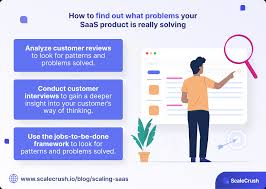
Finding a SaaS problem involves looking for genuine pain points that a significant number of people or businesses experience regularly. It’s about identifying frustrations, inefficiencies, or unmet needs within specific markets that software can effectively address. The goal is to find a problem that is not only real but also solvable and has a market willing to pay for a solution.
What is a SaaS Problem?
A SaaS problem is a specific challenge or unmet need that businesses or individuals face. This problem is something that can be solved or made much better using software delivered as a service. Think about things that are hard, take too long, or cost too much to do currently.
These are often good starting points.
Software as a Service, or SaaS, means the software is accessed online. You don’t install it on your computer. Companies like Google (Gmail, Docs) and Microsoft (Office 365) do this.
The problem needs to be something that software can handle better than existing methods. It should save time, reduce costs, or make things easier for users.
It’s not just about having a cool idea for an app. It’s about observing real-world struggles. What are people complaining about?
Where are businesses losing money or opportunities because of clunky processes? These are the goldmines for finding a SaaS problem.
My Own Search for a Problem
I remember a time when I was deeply frustrated with managing my small freelance projects. I was juggling multiple clients, deadlines, invoices, and communication. My spreadsheet was a mess.
My email inbox was overflowing. I felt like I spent more time organizing than actually doing the creative work I loved.
It was a Monday morning. Sunlight streamed through my office window, but I felt a familiar knot of dread in my stomach. My to-do list for the week was already daunting.
I had three client projects needing attention, invoices to send out for two completed jobs, and a new inquiry I hadn’t even responded to yet. My brain felt scattered. I looked at my giant spreadsheet, a jumble of client names, project statuses, and payment dates.
It was supposed to help, but it just made me feel overwhelmed. I thought, “There HAS to be a better way to keep all of this straight.” That feeling of being bogged down by administrative tasks was a real pain for me.
This personal struggle sparked my curiosity. Was I the only one feeling this way? Were other freelancers dealing with the same disorganization?
This wasn’t just a minor inconvenience. It was actively hindering my productivity and adding stress to my work. It felt like a problem that software could solve.
A tool that could bring all my client work, billing, and communication into one easy-to-manage place. This initial frustration was the first step in looking for a real need.
Where Problems Hide: Observing Daily Life
Observation is Key: Spend time watching how people work. Look for repetitive tasks. Notice what causes delays or mistakes.
Listen to Complaints: What do people grumble about at work? What frustrates them about their tools or processes?
Identify Inefficiencies: Where do you see wasted time or resources? Are there steps that could be skipped or automated?
Identifying Genuine Pain Points
Finding a real SaaS problem isn’t about inventing a problem. It’s about discovering one that already exists and causes significant pain. A pain point is something that hurts.
It makes life harder, costs money, or wastes precious time. People will pay to make their pain go away.
Think about the core needs of businesses and individuals. Are they trying to make money? Save money?
Save time? Reduce risk? Improve customer satisfaction?
If your potential SaaS solution can directly address one of these fundamental needs, you’re on the right track.
A good way to check if a problem is a genuine pain point is to ask: “Would someone pay money to have this solved?” If the answer is a clear yes, it’s likely a strong candidate. If it’s a “maybe” or “only if it’s cheap,” it might not be a pain point strong enough to build a business around.
It’s also important to consider the frequency and severity of the problem. Is it a daily headache or a once-a-year annoyance? The more frequent and severe the pain, the more likely people are to seek and pay for a solution.
The “Why Not Just Use a Spreadsheet?” Test
This is a crucial test for any potential SaaS problem. If the problem can be easily and adequately solved with a simple spreadsheet, a basic document, or a free online tool, it might not be a strong enough SaaS opportunity. People often use these basic tools because they are free or readily available.
They accept the limitations because the pain isn’t high enough to justify paying for something else.
A true SaaS problem usually involves complexity that spreadsheets can’t handle well. This could be:
- Real-time collaboration needs.
- Complex data analysis or reporting.
- Integration with other systems.
- Automation of intricate workflows.
- Handling large volumes of data securely.
- Providing advanced security features.
If you see people struggling with these kinds of issues, even while trying to use spreadsheets or other basic tools, then you’ve likely found a problem that a dedicated SaaS solution can truly solve. This is where the value proposition of your software becomes clear. You’re not just offering a different way to do something; you’re offering a better way that overcomes the limitations of current, simpler methods.
Contrast Matrix: Spreadsheet Solutions vs. SaaS Potential
Spreadsheet Strength: Simple lists, basic calculations, small data sets.
Spreadsheet Weakness: Collaboration, complex automation, real-time updates, large data, advanced security.
SaaS Opportunity: When a task requires what spreadsheets lack – like seamless team work, intricate automated processes, or instant, secure data access for many users.
Targeting Specific Industries or Niches
Trying to solve a problem for “everyone” is usually a recipe for failure. The most successful SaaS products often target a specific industry, a particular type of business, or a niche group of users. This focus allows you to deeply understand their unique challenges and build a tailored solution.
For example, instead of trying to build a general “project management tool,” you might focus on a “project management tool for dental practices.” Or instead of a generic “CRM,” you could build a “CRM for independent bookstores.” This specificity helps you:
- Understand the jargon and specific workflows.
- Identify unique regulations or compliance needs.
- Tailor features to exact requirements.
- Market your product more effectively to the right audience.
In my own experience, I realized my freelance project management frustration wasn’t unique to just me. It was common among many creative professionals. By focusing on this group – graphic designers, writers, consultants – I could see shared pain points.
They often worked with clients, managed contracts, and sent invoices. This narrow focus made the problem clearer and the potential solution more targeted.
This niche approach also helps in validation. It’s much easier to talk to 50 graphic designers about their project management issues than it is to find 50 random businesses from vastly different sectors and get meaningful feedback.
How to Find These Niche Problems
So, how do you actually uncover these niche-specific problems? It takes a bit of detective work. Here are some proven methods:
1. Dive into Online Communities
Websites like Reddit, LinkedIn groups, Slack channels, and industry-specific forums are treasure troves. Join groups related to industries you’re interested in. Observe the discussions.
What questions are people asking repeatedly? What problems are they venting about? What tools are they complaining about not having or wishing were better?
Look for patterns. If multiple people in a photography forum are asking how to manage client proofing efficiently, that’s a potential problem. If a group of small business owners are constantly discussing accounting headaches, that’s another clue.
2. Interview Potential Users
This is arguably the most important step. Once you have an idea for a problem area, talk to the people who experience it. Don’t pitch your solution yet.
Just listen. Ask open-ended questions about their work, their challenges, and their daily frustrations.
Some good questions include:
- “Tell me about a typical day for you at work.”
- “What are the biggest challenges you face in your role?”
- “What tasks take up the most time or energy?”
- “What tools or software do you currently use to manage ? What do you like and dislike about them?”
- “If you could wave a magic wand, what’s one thing you would change about your work process?”
During these conversations, pay close attention to their language. What words do they use to describe their frustrations? This insight can be invaluable when you later craft your marketing messages.
3. Analyze Existing Software and Reviews
Look at popular SaaS products in industries that interest you. What problems do they solve? More importantly, read their user reviews on sites like G2, Capterra, or even app stores.
What are users praising? What are they complaining about? Common complaints often point to unmet needs or areas where existing solutions are falling short.
For instance, if many reviews for a popular CRM mention that it’s too complex for small teams, that’s a signal. It suggests a need for a simpler, more focused CRM for that market segment.
Quick-Scan Table: Where to Find Problems
| Method | What to Look For | Example Clues |
|---|---|---|
| Online Communities | Repeated questions, complaints, frustrations | “How do I.” “I wish there was.” “This software is so bad at.” |
| User Interviews | Unmet needs, time sinks, inefficiencies | “It takes me 3 hours to.” “I always forget to.” “This is the worst part of my job.” |
| Software Reviews | Gaps in existing solutions, user dissatisfaction | “Too complicated for beginners,” “Missing feature X,” “Customer support is awful.” |
Validate Your Problem Idea
Once you think you’ve found a promising problem, you must validate it. This means checking if your problem idea is real and if people are willing to pay for a solution. Don’t skip this step!
It saves you a lot of time and money later on.
Validation isn’t just about asking people if they like your idea. It’s about understanding their current behavior and their willingness to change.
How to Validate
- Run Surveys: Create short surveys targeted at your niche audience. Ask about their current processes and the difficulties they encounter. Focus on quantifying the problem (e.g., “How many hours per week do you spend on X?”).
- More Interviews: Continue talking to potential users. Ask them how they currently solve the problem you’ve identified. How much do they spend (time and money) on their current solution? Would they consider paying for a new one?
- Landing Page Test: Create a simple landing page describing the problem and hinting at a solution. Offer a signup for early access or a waiting list. See how many people sign up. If many people show interest, it’s a good sign.
- Pre-Sales: For more advanced validation, you can even try to pre-sell your solution before you’ve built it. This is a strong indicator of demand.
Remember, validation is about gathering evidence. You want to see consistent signals that the problem is real, it’s painful, and people are actively looking for a better way. If your evidence is weak, it might be time to go back to the drawing board and look for a different problem.
Split Insight Panel: Validation Tells You When to Proceed
Validation is GO: Multiple people complain about the problem. They actively try to solve it now, often with workarounds. They express frustration and a desire for change.
They are willing to pay for a better way.
Validation is STOP/RETHINK: People don’t seem to notice the problem. They are happy with current methods. They can’t imagine paying for a solution.
The problem is a minor annoyance, not a true pain.
Understanding Market Size and Competition
Once you’ve identified a potential problem and validated it, you need to consider the market. How many people or businesses actually have this problem? This is your market size.
A very small market might not support a growing business.
Also, look at who else is trying to solve this problem. This is your competition. You don’t necessarily need to find a problem with zero competition.
Sometimes, competition shows that there’s a real market. However, you need to understand what makes your approach different and better.
Is your solution faster? Cheaper? Easier to use?
Does it serve a specific sub-niche better than anyone else? If you can’t answer these questions, you might struggle to gain traction. A competitive landscape isn’t always bad.
It can mean there’s a proven demand.
Think about the “Total Addressable Market” (TAM), “Serviceable Available Market” (SAM), and “Serviceable Obtainable Market” (SOM). You want to ensure that even a small slice of the market (SOM) can be enough to build a viable business.
Observational Flow: From Problem Idea to Market Fit
Step 1: Spot a Frustration
Step 2: Identify the Group Experiencing It
Step 3: Interview to Confirm Pain Level
Step 4: Ask if They’d Pay for a Fix
Step 5: Research Who Else is Trying to Fix It
Step 6: Determine if the Market is Big Enough
The Role of Expertise and Experience
Having experience or expertise in the area where you find a problem can be a huge advantage. It helps you:
- Spot problems others might miss.
- Understand the nuances of the problem.
- Talk credibly with potential customers.
- Build a solution that truly fits the need.
For instance, if you’ve worked in accounting for years, you’ll have a deep understanding of the challenges accountants face. This makes you better equipped to identify and solve their problems than someone without that background. This is key for E-E-A-T (Experience, Expertise, Authoritativeness, Trustworthiness).
Even if you don’t have direct experience, you can gain it. Spend time talking to experts, reading industry publications, and immersing yourself in the world of the problem you’re trying to solve. This dedication builds your own expertise over time.
I found my freelance project management problem because I was a freelancer. I felt the pain directly. This personal experience gave me the insight to know that the problem was significant.
It wasn’t just a theoretical issue; it was a real obstacle in my daily work life.
What This Means For You
Finding a SaaS problem is an active process. It requires curiosity, empathy, and a willingness to talk to people. Don’t expect the perfect idea to just land in your lap.
You need to go out and look for it.
The most important takeaway is to focus on the problem first, not the solution. Understand the pain deeply. Validate that the pain is real and that people are willing to pay for relief.
By following these steps, you increase your chances of building a SaaS product that people actually need and love.
It’s a journey, and sometimes you’ll explore several dead ends before finding a promising path. That’s completely normal. Every problem you investigate, even if it doesn’t lead to a product, teaches you something valuable about markets, people, and what makes a good business idea.
Quick Fixes & Tips for Problem Finding
Here are some actionable tips to help you on your quest:
- Keep a Notebook: Jot down every idea, observation, or frustration you notice.
- Talk to Everyone: Casually ask friends, family, and colleagues about their work challenges.
- Read Industry News: Stay informed about trends and shifts in different sectors.
- Focus on “How Might We.”: Frame potential problems as questions starting with “How might we.?” (e.g., “How might we make invoicing easier for small businesses?”).
- Look for Manual Processes: Where are people doing things by hand that could be automated with software?
- Seek Out Inefficiencies: Any process that is slow, clunky, or error-prone is a candidate.
Frequently Asked Questions
What is the difference between a problem and an idea?
An idea is a potential solution or concept. A problem is a specific pain point or unmet need that people experience. You find a problem first, then develop an idea to solve it.
How do I know if a problem is big enough to build a SaaS product around?
A problem is big enough if many people experience it, it causes significant pain (time, money, stress), and they are actively trying to solve it now. If people are willing to pay for a better solution, that’s a strong sign.
Is it okay to solve a problem I don’t have myself?
Yes, but it’s harder. If you don’t have the problem, you need to do extra work to deeply understand it. Thorough research and interviewing people who experience the problem are crucial.
What if multiple people have the same idea for a solution?
Having the same idea as others often means you’ve found a real market need. Focus on your unique approach, your understanding of the niche, and your ability to execute better or serve a specific segment more effectively.
Should I look for problems in high-tech or low-tech industries?
Both can have opportunities. High-tech industries might have complex software needs. Low-tech industries might have opportunities for digitizing manual processes.
The key is identifying a genuine, painful problem that software can solve better.
How long should I spend looking for a problem?
There’s no set time. Dedicate consistent effort. It might take weeks or months.
The goal is to find a validated problem, not just the first problem you encounter. Be patient but persistent.
Conclusion
Finding a compelling SaaS problem is the foundation of a successful business. It requires digging deep into the real-world struggles of others. By listening, observing, and validating, you can uncover opportunities that others miss.
Focus on solving genuine pain, and you’ll be well on your way to building something valuable.